
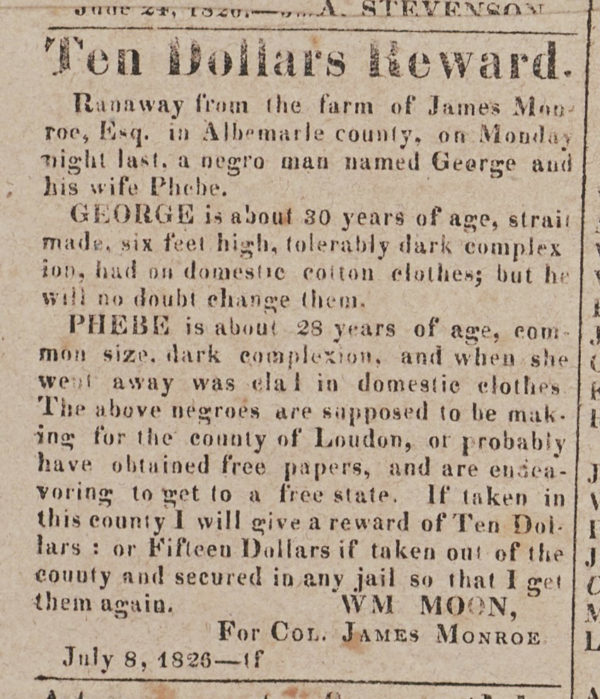
– The Central Gazette, July 15, 1826, University of Virginia Special Collections
“The god who made us, made the black people, & they ought not to be treated with barbarity.”
– James Monroe to Charles Everett, April 25, 1812.
“The difficulty attending it, is, the danger, in case, of not supporting the authority of the overseer, that the negroes will be encouraged in their disobedience & he rendered useless.”
-James Monroe to William Noland, February 26, 1817.
It is impossible to separate James Monroe’s enslavement of others from his status as a founder. Likewise, the inhumane nature of slavery cannot be divorced from Monroe’s opposition to the institution, representing a contradiction evident in many of his actions and writings. In a letter to William Benton from 1822, for example, Monroe expressed concern for George, an enslaved worker with an injured leg, “on the account of humanity” as well as “the values of the servant.” Monroe’s writings indicate that he morally opposed slavery, though for financial and political reasons never abandoned the practice. Monroe belonged to the Virginia planter class, an aristocracy built upon property ownership, referring to both land and enslaved persons, which afforded him many opportunities throughout his life. Monroe was also an absentee landowner, meaning the day to day responsibilities of owning a plantation were left to overseers while he worked elsewhere. The financial success of Highland depended on this authority. Further impacting Highland’s finances was the growth of cotton plantations in the Deep South, which caused an economic shift Virginia eventually could no longer compete with.
The forced labor done by enslaved men and women at Highland can be divided into three categories: domestic work, field work, and work in crafts such as carpentry, blacksmithing, and weaving. For more information about the individual experiences of enslaved workers at Highland, visit: https://highland.org/enslaved-biographies/.
The selected primary sources present Monroe’s contradictions pertaining to slavery, while also giving voice to enslaved workers and demonstrating agency against their enslavement. The letters to William Noland and Fulwar Skipwith reveal specific dilemmas Monroe faced regarding Roger, Ralph, and Ralph’s wife. The advertisement for George and Phebe, as well as the recollections of Garland Monroe, offer examples of resistance. The manumission papers of Peter Marks provide valuable insight into the only instance when Monroe freed one of his enslaved workers.
Document Based Questions
Letter to Major Noland February 26, 1817 (Courtesy of the University of Virginia) View
- What is ironic about James Monroe’s assertion that his enslaved workers should not be “cruelly treated?”
- Why did James Monroe consider the incident between Mr. Jennings and Ralph to be an “unfavorable circumstance?”
- How does this letter shed light on James Monroe’s difficulties in being an absentee landowner?
Manumission Papers of Peter Marks (Courtesy of the Historical Society of Pennsylvania)
Tench Ringgold, Recommendation of Peter Marks, 27 August 1831 View
Samuel L. Gouverneur, Certification of Peter Marx’s status as a free person, 20 September 1832 View
- What qualities was Peter Marks commended for by Tench Ringgold?
- What would the certification of Peter Marks’ status mean to him?
- Why might James Monroe have freed Peter Marks?
Letter to Fulwar Skipwith October 9, 1810 (Courtesy of the New York Public Library) View
- Why did James Monroe write this letter to Fulwar Skipwith?
- In what way did James Monroe accommodate Roger?
- How did James Monroe describe the effect of his absence on Highland?
- What does this letter disclose about James Monroe’s ownership of enslaved individuals?
The Negro in Virginia (Public Domain) View
- Why did Garland Monroe’s family meet the “stump preacher” in the woods near Monticello?
- How did Garland Monroe’s brother Henry escape from the patrollers?
- How could the passage of time influence Garland Monroe’s recollections?
- How does the bias of the writer and era in which it was recorded support stereotypes about African-Americans?
The Central Gazette, July 15, 1826 (Courtesy of the University of Virginia) View
- What elements of agency and resistance are evident in this advertisement?
- What can be learned about George and Phebe from this advertisement?
- Can you tell what date George and Phebe ran away? Is there a significance to that date?
Essential Questions
- What do these sources reveal about the institution of slavery?
- How do primary source documents give voice to the enslaved and highlight their resistance to slavery?
- How should society today remember James Monroe in light of his accomplishments and enslavement of people?
- Why would James Monroe continue to enslave people despite expressing opposition to the institution?
Virginia Standards of Learning
Skills CE The student will apply history and social science skills to the content by
c) developing questions, enhancing curiosity, and engaging in critical thinking and analysis;
d) integrating evidence to construct and analyze timelines, classify events, and to distinguish fact and opinion;
USI.5 The student will apply history and social science skills to explain the social, political, religious, economic, and geographic factors that shaped colonial America by
c) comparing life from the perspectives of various groups including, but not limited to large landowners, farmers, artisans, clergy, merchants, women, indentured servants, and enslaved and free Blacks;
VUS.3 The student will apply history and social science skills to explain the development of African American culture in America and the impact of the institution of slavery by
c) describing the slave trade in the U.S., Virginia, and Richmond;
d) analyzing the growth of the colonial economy that maximized profits through the use of indentured servitude and race-based enslavement of Africans; and
e) examining the cultures of enslaved Africans and identifying the various ways they persisted towards freedom.
Bibliography & Suggested Readings
Fleming, Kevin. “Highland: Research on Monroe, his properties, and his slaves.” (2013).
Gawalt, Gerard W. “James Monroe, Presidential Planter.” The Virginia Magazine of History and Biography 101, No. 2 (April 1993): pp. 251-272.
Hammond, John C. “President, Planter, Politician: James Monroe, the Missouri Crisis, and the Politics of Slavery.” The Journal of American History (March 2019): pp. 843-867.
Leshan, Bruce. “President James Monroe enslaved hundreds of people. Now, their descendants are helping re-write his story.” WUSA9. January 27, 2020. https://www.wusa9.com/article/news/local/president-monroe-descendants-rewriting-history-virginia/65-754500bd-bdfd-4b10-8f3d-755f9cfa5316.
Preston, Daniel. “James Monroe and the Practicalities of Emancipation and Colonization.” in New Directions in the Study of African Recolonization, Eds. Beverly C. Tomek et al. Gainesville: University Press of Florida, 2017. pp. 1-14.
Scherr, Arthur. “Governor James Monroe and the Southhampton Slave Resistance of 1799.” The Historian 61, No. 3 (Spring 1999): pp. 557-578.
Svrluga, Susan. “Descendants of Enslaved Blacks Explore Virginia History.” The Washington Post. December 13, 2020. https://www.washingtonpost.com/education/2020/12/13/william-and-mary-slavery-oral-history/.